Monday, October 27, 2014

Oso Bay Park


I wasn't sure I'd found a separate park so I had to do a bit of online research to confirm.  The path below leads all the way to Hans A Suter Wildlife Area, and it's difficult to say where one ends and other begins.  After failing to locate the Godwits earlier in the day at Suter, I explored Oso Bay Park until sunset.  


There were flyovers of Spoonbills, Cormorants, and Ibis.  A Willet hunted in the surf.  


I also found a Semipalmated Plover...


...and a Western Sandpiper, but no Godwits.


These little peeps are challenging to identify.  I took a second glance at this one's legs and thought they might be yellowish, then remembered they were muddy.  I have other photos in which I can see the bill is slightly downcurved.  Black legs plus downcurved bill equals Western Sandpiper.    


The Neotropic Cormorants used large pieces of debris scattered about the bay as perches.


I'm linking up this week with Camera Critters.

CTC068
8/31/2014
Evening
90 deg F
Windy
Species identified (13):  Brown Pelican, Great Blue Heron, Willet, Western Sandpiper, Laughing Gull, Black-necked Stilt, White Ibis, Roseate Spoonbill, Neotropic Cormorant, Mourning Dove, Snowy Egret, Northern Cardinal, Semipalmated Plover

Saturday, October 25, 2014

Hans A Suter Wildlife Area

Oops!  I just realized I posted out of order again.  I still have a couple of August posts to make.  The weekend of August 31 I made a trip to Corpus Christi in search of another rarity, the Bar-tailed Godwit that had been seen around Oso Bay.  Whether or not my trip was a success depends on your definition.  I visited two more sites of the Great Texas Coastal Birding Trail, which is the original purpose of this blog.  I did not get the added bonus of a rare bird sighting.  Not this time, anyway...     


Splashdown!  The America White Pelicans had already returned.  A local man at the wildlife area told me they arrived more than a month ago.  I'm learning not to take the descriptions of best season to visit these sites too literally.  The birds don't.  Winter species can be found in July.


This photo of Oso Bay was taken from the railing on Ennis Joslin Road.  I not only visited Hans Suter, I accessed the flats via a small footpath worn into the weeded area on the roadside.  That's Texas A&M on the other side.  I found egrets, herons, terns, gulls, and skimmers on the sand and in the shallows.


At first glance, I thought it was a Great Egret, but the bill was wrong.  It didn't have yellow feet, so it couldn't be a Snowy.  I studied my field guides and decided it must be a juvenile Little Blue Heron, but the leg color still wasn't quite right.  Then, I saw a similar bird on Hootin' Anni's blog.  Due to it's size and dark legs, I'm calling it a white-morph Reddish Egret.

The Great Egret is below, for comparison.  I found him near the overpass on Ocean Drive.


 I walked all the way from Hans Suter, up onto Ocean Drive and the bridge that crosses Oso Bay, to Texas A&M in search of the Godwit.  I didn't find him or the Marbled Godwits with which he'd been seen.         


One last visit to the boardwalk and viewing area at Hans Suter before I left rewarded me with views of the Great Blue Heron, pelicans, stilts, and sandpipers.  

This week, I'm linking up with I'd Rather B' Birdin'.


CTC069
Late afternoon 8/31 - midday 9/1/2014
90 deg F
Partly cloudy, windy
Species identified (17):  American White Pelican, Brown Pelican, Great Blue Heron, Willet, Western Sandpiper, Laughing Gull, Black-necked Stilt, Caspian Tern, Great Egret, Reddish Egret, Black Skimmer, Sanderling, White Ibis, Crested Caracara, Mottled Duck, Roseate Spoonbill, Snowy Egret

Wednesday, October 22, 2014

Bear Creek Park

Finally, I'm done with the older posts and working on the newish ones.  I may never be completely current.

On September 28, I chased a bird closer to home.  Just because it was spotted in the Houston area doesn't mean I didn't drive an hour and a half each way, though.

Bear Creek Park is on the northwest side of the city.  My information was that a rare bird was spotted near restroom number 9.  I wasn't familiar with the park and the first restrooms I saw had no numbers.  How do you know if it's number nine?              


I found quite a large group of Black Vultures at the pond near the War Memorial.  


I found these beside the same pond.  My first thought was did a whistling duck hook up with an ugly domestic muscovy?  They need to stop that...  I was able to identify it as an Egyptian Goose by looking through my field guides.  These are imported as ornamentals and some of them escape.

They brought it here on purpose?  Why?  Our native species are much more attractive.


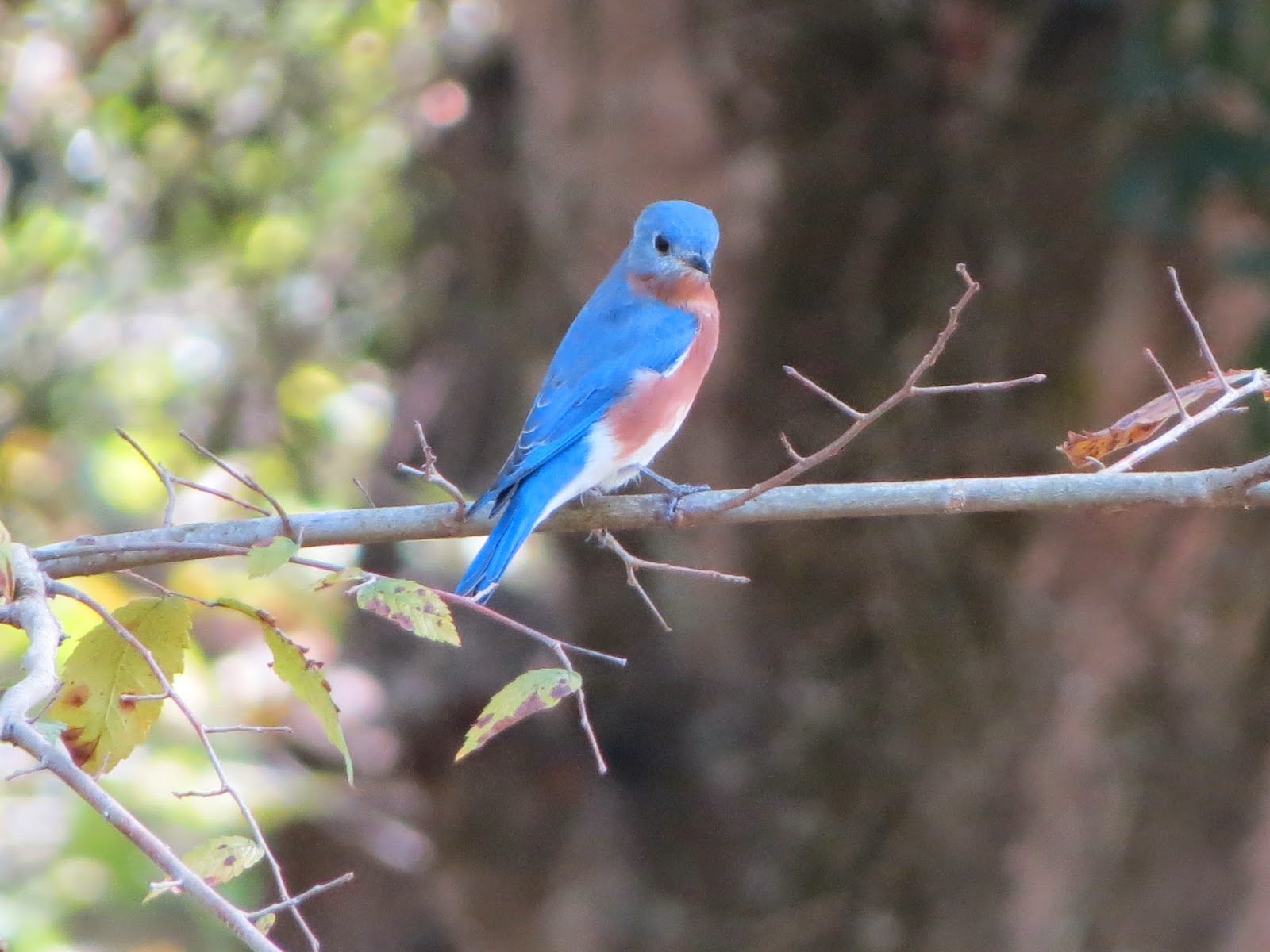
I worked my way around the park, past the zoo area, past the ballfields, around to the picnic pavilions.  Here is where I found Eastern Bluebirds, Pine Warblers, House Finches, and Titmice.  I thought maybe I found my special bird, but I wasn't positive.  


I continued further into the park and finally found the wooded area with the numbered restrooms.  The special bird wasn't here, but I found plenty more bluebirds, chickadees, and titmice.  I got my first ever good photograph of a Tufted Titmouse.

I went home, uploaded my photos, and confirmed...  


...it was him by the pavilions!  He's got the longer tail, slender crest, pale lower mandible, and blended underparts that identify him as the Greater Pewee.  What's more interesting than the fact that he is supposed to be found in the western U.S. and Mexico is that he's not lost.  This is believed to be his third winter here in Bear Creek Park.

I wonder where he spends his summers?  If someone were to tag him, would he avoid returning next year?        

I'm linking up with Wild Bird Wednesday.

UTC097
September 2014
Midday
Sunny
Upper 80's
Species Identified(14):  Great Egret, Black Vulture, Egyptian Goose, Graylag Goose - domestic, Muscovy Duck - domestic variety, Mallard, Mourning Dove, Eastern Bluebird, House Finch, Greater Pewee, American Crow, Carolina Chickadee, Tufted Titmouse, Pine Warbler

Saturday, October 18, 2014

Mad Island WMA

The Mad Island Wildlife Management Area and the Clive Runnels Family Mad Island Marsh Preserve are both closed to the public, but access may be arranged on special occasions.  When a White-cheeked Pintail was spotted on the WMA, someone was kind enough to organize such a visit.  

May 3, 2014, a group of birders, myself included, relocated the bird.  If you were to enlarge the picture below, you'd see the duck off by himself to the right of the larger group has a sharply delineated white cheek.  

The White-cheeked Pintail is a vagrant from the Caribbean.  There was some controversy over whether this one should be counted as a wild bird or if he is an escapee.  I'm not sure what was officially decided, but I'm counting him on my life list.  


One benefit of a large group of birders is more eyes to spot and identify the birds.  A drawback is that we can't get very close.  I got a good look at the White-cheeked Pintail through someone's scope.

Several people generously shared their equipment and expertise on this day.  After I reacted with great excitement at seeing my first Glossy Ibis, they came and got me when they found another.  I have found birders to be incredibly friendly people.    


When I first arrived, I noticed several people in knee-high rubber boots.  I asked if we were going to actually need to wade in the water and was a little confused when they gave negative responses.  It wasn't too long before I realized the purpose of the boots.

The Western Massasauga Rattlesnake was vigorously making his presence known.  "Be careful," someone warned.  "A snake that size can strike 20 feet."

Snakes can generally strike half of their body distance, and this was certainly not a 40-foot snake, but I allowed him plenty of space anyway.  That's what zoom lenses are for.    


I found the Swift Long-winged Skimmer not far from the rattler.  I hear tell of people that go "bugging" as well as birding.  I already have enough expensive habits.  I will photograph them when  I cross paths with them, though.


At least 53 species were identified by our group.  Most were too far away for close-ups.  Above is a Canvasback, a lifer for me.  He's the one in the grass not sleeping.


The Wilson's Phalarope, seen here to the right of a Lesser Yellowlegs, was another.

I'm linking up this week with Saturday's Critters.

CTC007
5/3/2014
8am - 1:30pm
80's, sunny
Species Identified (53):  White-cheeked Pintail, Northern Pintail, Blue-winged Teal, Red-winged Blackbird, Redhead, Yellow-Crowned Night-Heron, White Ibis, White-faced Ibis, Glossy Ibis, Great Egret, Snowy Egret, Cattle Egret, Little Blue Heron, Reddish Egret, Sora, Least Sandpiper, Willet, White-rumped Sandpiper, Baird's Sandpiper, Dunlin, Pectoral Sandpiper, Stilt Sandpiper, Laughing Gull, Forster's Tern, Gull-billed Tern, Black Tern, Caspian Tern, Royal Tern, Seaside Sparrow, Northern Shoveler, Purple Gallinule, American Coot, American Golden Plover, Semipalmated Plover, American Avocet, Black-necked Stilt, American Wigeon, Boat-tailed Grackle, Canvasback, Semipalmated Sandpiper, Bronzed Cowbird, Brown-headed Cowbird, Belted Kingfisher, Greater Scaup, Northern Bobwhite, Lesser Yellowlegs, Wilson's Phalarope, Chipping Sparrow, Scissor-tailed Flycatcher, Whimbrel, Savannah Sparrow, Tri-colored Heron, Common Moorhen


Sunday, September 14, 2014

Attwater Prairie-Chicken NWR

I've passed this site before and didn't have time to stop.  I took a different route home from Rockport so I could finally visit.  The Attwater Prairie-Chicken NWR is home to the very endangered bird for which it is named.  One of my field guides lists it as a smaller, darker race of Greater Prairie-Chicken that is nearly extinct.  They are always here, but you may or may not see them.  Even though I didn't catch a glimpse of the prairie chicken, I did add two birds to my life list.  


I found the first at the very beginning of the auto loop.  A Bobwhite stepped in front of my car.  I took a few photos through the windshield to make sure I didn't frighten him, then waited.  He showed no sign of moving on so I opened the door, stood up behind it, and took more photos.  Still, he didn't budge.  I probably photographed him for 10 minutes before he finally joined his friends in the grass beside the trail.  I couldn't see his buddies, but heard them calling, "Bob-white...bob-white..."

This one looks like the Florida subspecies.  What's he doing in Texas?

This leads to a question one of the more experienced birders reading might be able to answer:  If I see the other subspecies, do I count each one on my life list?
 

I saw the other new one soon after.  Some other birders and I were trying to figure out what he was.  "Maybe some kind of warbler, but I don't know the name."

"I'll call him George," said one of the guys.

"George" was everywhere.  Not in large groups, but one here and one there throughout the entire reserve.  I must have seen at least 100.  I saw so many, I stopped looking at the birds singing from their perches atop the tall grass.  It's just George again, I thought to myself.

"George" turned out to be a Dickcissel, one of our summer birds who breeds here and flies south to Mexico and Central America for the winter.    


After the auto trail, I took a short stroll along the Pipit Trail.  Most of the reserve looks like this, similar to what you would expect to see in the Great Plains.  For those who might not know, Texas contains beaches, swamps, prairies, forests, canyons, caverns, mountains, valleys and deserts.  I'm not sure there is another state with such diversity.

We do have lakes as well, but only one is natural.      


Along the Pipit Trail, I found another butterfly to photograph - the Buckeye.  


I also found his caterpillar.


CTC004
4/27/2014
mid-late afternoon
80's, overcast, windy
Species Identified (13):  Little Blue Heron, Turkey Vulture, Crested Caracara, Red-winged Blackbird, Dickcissel, Northern Bobwhite, Anhinga, Northern Mockingbird, Common Moorhen, Barn Swallow, Great Egret, Scissor-tailed Flycatcher, Northern Cardinal

I'm linking up with I'd Rather B Birdin'.  Another Texas birder hosts a linkup for birders around the world.

Friday, September 12, 2014

Newbury Park Hummingbird Garden

My last stop before heading home was a small city park in Lamont.  There weren't many birds, but it was the perfect spot for a sandwich and a potty break.   


April was not the month for the tens of thousands of Hummingbirds that migrate through the area each year.  I did find some migrants, though.


There were several Monarch Butterflies in the garden.


They are "capable of flying 2,000 miles from Canada to Mexico and back again to the Southern US" per my field guide.  Wow.    


So many shades of orange are in these flowers and butterflies, I think I have the perfect post to link up with Orange You Glad It's Friday.


Even the Variegated Fritillary is sort of an orange color.  I did not find him in my field guide.  I had to search the internet when I got home.  I think I may need a new one devoted specifically to butterflies and moths.  I'm working on a library, apparently.

CTC052
4/27/2014
Mid-morning
Overcast
80's
Great-tailed Grackle, Monarch Butterfly, Variegated Fritillary
  

Tuesday, September 9, 2014

Connie Hagar Cottage Sanctuary


I'm still catching up on posts from April.  This is as much a personal scrapbook / photo album documenting my journey along the Texas wildlife trails as anything else, so I want to include each and every site I've visited so far.  I'm thinking of having it turned into one of those books I see advertised at the end of each year.  Has anyone done that?  


The first photos were taken at the Connie Hagar Wildlife Sanctuary, which the map suggests visiting on the way to site 51.   


From the tiny parking lot , I observed a Willet, Laughing Gulls, Brown Pelicans, and a Mottled Duck.


Even now I keep checking my books to make sure he's a Laughing Gull.  He's missing the large white wingtip spots of a Franklin's Gull, though.  I never knew there were so many types of gulls.


These last two photos were taken on the grounds of the Connie Hagar Cottage Sanctuary.  Connie Hagar seems to be well known to the birders in this area.  She and her husband owned and operated a motel here, the Rockport Cottages, in the 1930's and she was responsible for putting this area on the map.  Apparently, before she alerted the birding world, no one knew about the migratory flyways on the Texas Gulf Coast.


I found no kiosk or daily bird list, even though the map mentions them.  I did identify several species, including a new one for me - the Magnolia Warbler.  I didn't get any good photos of the birds, but the trails and flowers are pretty enough.

The  guide map also mentions that Rockport is the base for boats that visit the feeding grounds of Whooping Cranes and nesting islands for colonial waterbirds.  I did not have the time or the funds for such a tour on this trip, but I will be back.

4/27/2014, early morning
CTC051
Overcast
80's
Species Identified: Willet, Laughing Gull, Brown Pelican, Mottled Duck, Eurasian Collared-dove, Northern Cardinal, Tufted Titmouse, Magnolia Warbler, Great-tailed Grackle, European Starling, Great Egret, Roseated Spoonbill, Northern Mockingbird  

I'm linking with Our World Tuesday this week.