Friday, November 7, 2014

Swantner Park

Trip Date:  10/18/2014

My regular readers may recall that I went to Corpus Christi in search of the Bar-tailed Godwit, but couldn't find him.  He was relocated in a small bayfront park along Ocean Drive, so I headed back again for another try.  According to my field guide, this is a common bird in Alaska, who normally flies nonstop in fall to southwest Pacific wintering grounds.  Texas is far from Alaska or the Pacific, but he found his way here.


This is my entry for Skywatch Friday.  Those clouds dumped quite a bit of rain on the city that weekend.  Visibility was so bad that highway traffic was moving only 20 mph at times.  I crossed the causeway without realizing I'd even reached the bridge, so intent was my concentration on the road so I wouldn't end up in deep water or the back seat of the car ahead.  The original plan was to continue south to the Lower Rio Grande Valley if I found my bird quickly.  Flood warnings changed my mind.  


Long-billed Curlew

The Bar-tailed Godwit was reported to be hanging out with a mixed flock of Marbled Godwits and Long-billed Curlews.  The curlews were visible from the road as soon as I reached the park.  I pulled into the parking lot, grabbed my binoculars, and scanned the nearby godwits to find the one that was not like the others.      


Marbled (left, darker) and Bar-tailed Godwit

There he is, grooming in the rain like God turned on the shower just for him.  He has an incredibly bendy neck.  

I took a few photos, then got back in my car to find a nearby hotel room where I could wait out the storm.

Franklin's Gulls

There were still a couple of hours of daylight left after the rain stopped, so I headed back out to see what else was hanging out at Swantner Park.  I asked another birder and he said, "Lots of Franklin's Gulls."

What?  I assumed I was looking at Laughing Gulls.  I should have paid more attention.  The Franklin has a half hood, whereas the Laughing only has earmuffs.  The wing pattern of his buddy confirms the ID.  


Sanderling (front, lighter) and Ruddy Turnstones

Approaching the bay, I noticed there were steps leading down to the water, similar to those found on the seawall, but not as tall.  There I found waders and shorebirds such as these Ruddy Turnstones and Sanderling.  

This is not a numbered birding trail site, though it is found along the Central Texas Coast section of the Great Texas Coastal Birding Trail.
10/18/2014
Early Afternoon
80's
Rain
Species Identified (15):  Marbled Godwit, Bar-tailed Godwit, Long-billed Curlew, Killdeer, American White Pelican, Franklin's Gull, Sanderling, Ruddy Turnstone, Semipalmated Sandpiper, Great Blue Heron, Double-crested Cormorant, Willet, Laughing Gull, Great-tailed Grackle, Rock Pigeon


Wednesday, November 5, 2014

Lion's / Shelley Park (Refugio)

My last stop on this 3-day birding trip was a dinner break on my way home.  The small town park had a nice little nature trail on which to stretch my legs.  All of these beautiful trees must contain birds, but they weren't very active.  There was only a Turkey Vulture flying overhead and the occasional small flock too distant to identify as the birds crossed the sky.


I found a Red-eared Slider enjoying the river.


I ate my dinner in the shady picnic area.


I didn't want to leave without a picture of something feathered, so I took another lap around the nature trail.


Finally!  I found a Ladder-backed Woodpecker willing to be photographed.  Another lifer.  I believe I live just outside their range.


I watched for a little while, took some photos, and then drove another several hours home.

I'm linking with Outdoor Wednesday.

Outdoor Wednesday: Click on the picture below to learn more...


CTC038
Evening
Sunny, Clear, 80's
Species Identified (2):  Turkey Vulture, Ladder-backed Woodpecker


Monday, November 3, 2014

Bentsen-Rio Grande Valley SP / World Birding Center HQ

After finding the redstart, I still had the whole weekend before I needed to be back home, so I headed further south to Bentsen-Rio Grande Valley State Park.  I asked the ranger on duty at the office where to find the birds in the midday and they said, "Right here by the headquarters.  We're not feeding them at the stations yet."       


She was right.  I found more birds at the entrance than I did anywhere else, including the Curve-billed Thrasher...


...Black Phoebe...


...and Buff-bellied Hummingbird.


Cars are not allowed to travel throughout the park.  Visitors explore by foot, on bicycles, or via the free tram that was running once an hour.  Schedules do change by the season, so check ahead.    
I plan to bring my bicycle next time I visit, but they do have some to rent if you don't own your own.

I took a ride on the tram to get acquainted with the layout of the park and learned from the driver that I arrived a few days too early to see the birds at feeders.  He said once the natural food sources become scarce, they get quite a few feathered visitors throughout the park.

"And we're doing  hawk watch tomorrow morning if you can come back."

Well, of course I can.
         

None of the hawks came close enough to the tower for a good photo.   I did get a shot of the Couch's Kingbird that sat atop a tree, watching us watch the hawks.

The next morning was cool with no breeze, not a good day to see the huge numbers of hawks often observed during the height of migration.  The hawks wait for the air to warm and then ride the thermals upward.  "They are in unfamiliar territory and don't know when or where they will find their next meal.  You won't often see them wasting calories flapping," said the man leading the watch.  I should have taken pen and paper to take notes.  He was full of information that he was happy to share and I know I can't remember it all.

I asked questions like "how do you know you're not counting the same birds multiple times?"  Because they count each kettle and then wait for them to clear out before counting the next group, and they only count the ones headed south.  "Do you estimate, or count 1, 2, 3, 4?"  Sometimes they have to estimate, but if the birds are streaming they pick a landmark and count them as they pass it.  Or they can hold binoculars steady and count as the birds pass through their field of view.        

There was a family with three children that joined the watch, as well.  All were better birders than I.  The boy had a pen and paper, and he wrote down the lifers he helped me to identify, some by their calls alone.  Seven!  I think he was more excited than I was each time we found a new one, racing back to his notebook.  

My timing was off, but it's hard to call a day with seven lifers anything but a good day of birding.

I'm linking up with the Bird D'pot.

LTC069
10/4/2014 Midday Clear, Sunny  Low 90's
and 10/5/2014 Morning - Overcast, Cool(ish), No wind
Species Identified (20): Great-tailed Grackle, Curve-billed Thrasher, Black Phoebe, Buff-bellied Hummingbird, Great Kiskadee, Green Jay, Northern Cardinal, Turkey Vulture, Neotropic Cormorant, Double-crested Cormorant, Couch's Kingbird, Blue-gray Gnatcatcher, Plain Chachalaca, Northern Harrier, Altamira Oriole, Swainson's Hawk, White-eyed Vireo, Cooper's Hawk, Broad-winged Hawk, American Kestrel


Wednesday, October 29, 2014

TxDOT Brooks County Rest Area

The first weekend in October, I celebrated my birthday by taking Friday off work and heading south in search of yet another rare bird.  Yes, I've been doing a lot of that lately.  This one has been seen in the evenings, so I allowed myself to sleep in.  I took my time having breakfast, packing, doing a few chores so I wouldn't come home to a filthy apartment, and I was off to the Brooks County Rest Area, aka the Falfurrias rest stop.  I arrived in the late afternoon.  Sitting at one of the picnic tables, watching me, waiting to be noticed, was one of the most beautiful birds I have ever seen.    


The Painted Redstart is a western species far from his normal range.  It has been said he might be the same bird that spent a couple of months here last year.  I think it has to be.  What are the odds of two individuals finding their way here?

I took several photographs before he flew off into the trees.  He didn't go far, though, and I swear he expected me to follow.  He seems to know he's the main attraction.  Someone remarked on the Texbirds sight that he is "quite a ham".  I agree.  He even sang his beautiful song right to me.  


I spent a little time admiring the redstart, then took a look around the rest of the site.  I'm normally excited to see woodpeckers, but I was trying to photograph a Green Jay.  I'd focus, push the button, and then the jay was gone, a Golden-fronted Woodpecker in his place.  


The woodpeckers were after the Great Kiskadee, too.  They didn't want to share the fruit hanging from the palm tree.  He wasn't here long before they ran him off.  He returned several times to steal a bite or two at a time.  


I stayed until sunset on Friday, enjoyed my dinner in the picnic area, and found a hotel to spend the night before heading further south in search of Rio Grande Valley specialties.  


I stopped by again on my way back north and found a Summer Tanager.  The woodpeckers were still chasing the Kiskadee, Jays, and Kingbirds, and the Redstart was still there.  I saw some people who looked like birders - they're the ones with binoculars, staring up at the trees - and decided it was my chance to pay it forward.  So many have been helping me, and it was finally my turn to be helpful.

"Are you looking for the redstart?" I asked.  "I just saw him beside the restrooms," and I led them to him.

Add this site to my short list of favorites.  The birds seem active all day.  I think I'll be stopping here every time I head south on US281.  

I'm linking up this week with Wild Bird Wednesday.

LTC004
10/3/2014 Evening, and 10/5/2014 Midday
Upper 80's
Clear, Sunny skies
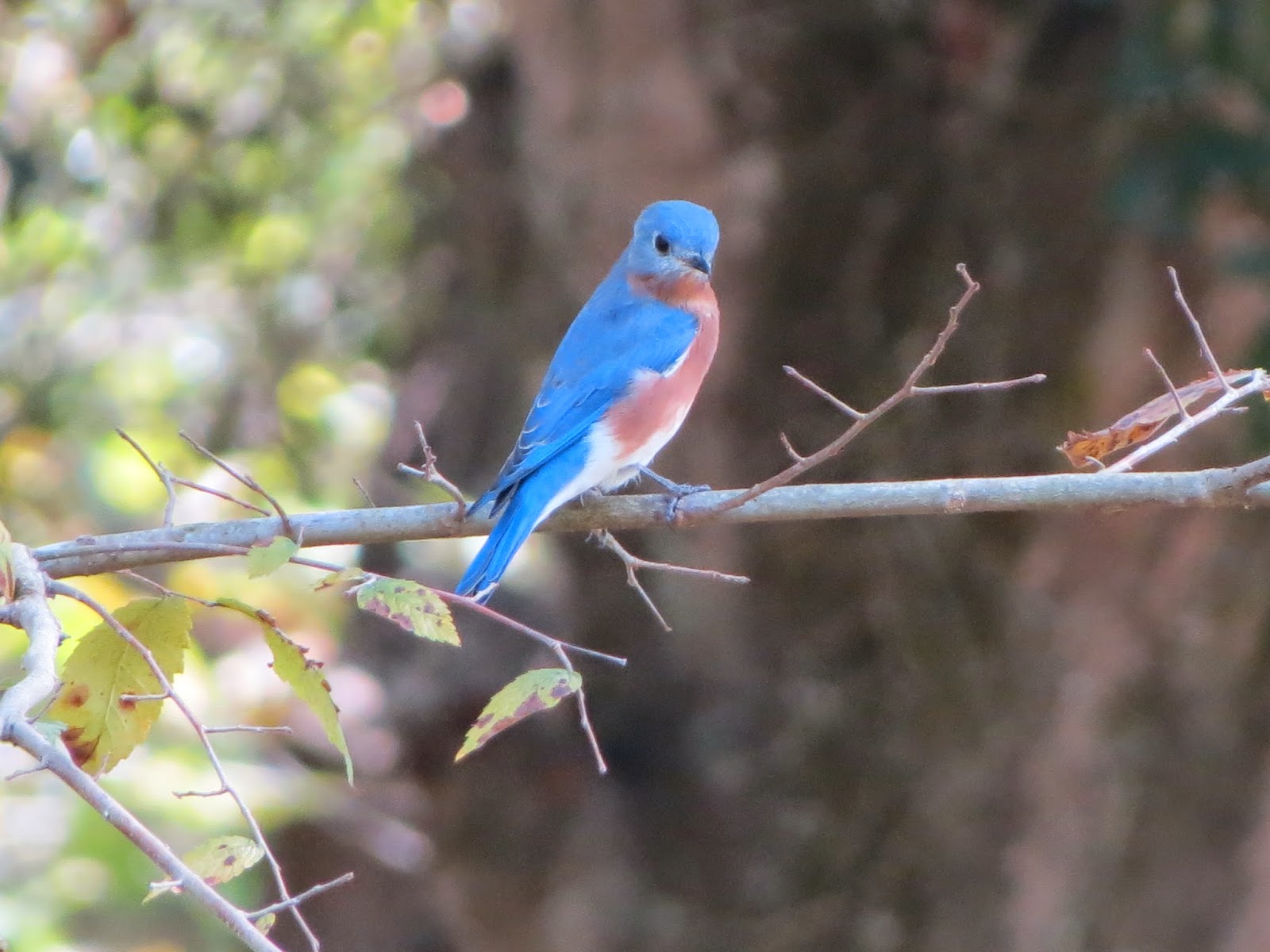
Species Identified (12):  Painted Redstart, Green Jay, Golden-fronted Woodpecker, Eastern Bluebird, Turkey Vulture, Black Vulture, Eurasian Collared-dove, American Goldfinch, Great Kiskadee, Couch's Kingbird, Summer Tanager, Lesser Goldfinch


Monday, October 27, 2014

Oso Bay Park


I wasn't sure I'd found a separate park so I had to do a bit of online research to confirm.  The path below leads all the way to Hans A Suter Wildlife Area, and it's difficult to say where one ends and other begins.  After failing to locate the Godwits earlier in the day at Suter, I explored Oso Bay Park until sunset.  


There were flyovers of Spoonbills, Cormorants, and Ibis.  A Willet hunted in the surf.  


I also found a Semipalmated Plover...


...and a Western Sandpiper, but no Godwits.


These little peeps are challenging to identify.  I took a second glance at this one's legs and thought they might be yellowish, then remembered they were muddy.  I have other photos in which I can see the bill is slightly downcurved.  Black legs plus downcurved bill equals Western Sandpiper.    


The Neotropic Cormorants used large pieces of debris scattered about the bay as perches.


I'm linking up this week with Camera Critters.

CTC068
8/31/2014
Evening
90 deg F
Windy
Species identified (13):  Brown Pelican, Great Blue Heron, Willet, Western Sandpiper, Laughing Gull, Black-necked Stilt, White Ibis, Roseate Spoonbill, Neotropic Cormorant, Mourning Dove, Snowy Egret, Northern Cardinal, Semipalmated Plover

Saturday, October 25, 2014

Hans A Suter Wildlife Area

Oops!  I just realized I posted out of order again.  I still have a couple of August posts to make.  The weekend of August 31 I made a trip to Corpus Christi in search of another rarity, the Bar-tailed Godwit that had been seen around Oso Bay.  Whether or not my trip was a success depends on your definition.  I visited two more sites of the Great Texas Coastal Birding Trail, which is the original purpose of this blog.  I did not get the added bonus of a rare bird sighting.  Not this time, anyway...     


Splashdown!  The America White Pelicans had already returned.  A local man at the wildlife area told me they arrived more than a month ago.  I'm learning not to take the descriptions of best season to visit these sites too literally.  The birds don't.  Winter species can be found in July.


This photo of Oso Bay was taken from the railing on Ennis Joslin Road.  I not only visited Hans Suter, I accessed the flats via a small footpath worn into the weeded area on the roadside.  That's Texas A&M on the other side.  I found egrets, herons, terns, gulls, and skimmers on the sand and in the shallows.


At first glance, I thought it was a Great Egret, but the bill was wrong.  It didn't have yellow feet, so it couldn't be a Snowy.  I studied my field guides and decided it must be a juvenile Little Blue Heron, but the leg color still wasn't quite right.  Then, I saw a similar bird on Hootin' Anni's blog.  Due to it's size and dark legs, I'm calling it a white-morph Reddish Egret.

The Great Egret is below, for comparison.  I found him near the overpass on Ocean Drive.


 I walked all the way from Hans Suter, up onto Ocean Drive and the bridge that crosses Oso Bay, to Texas A&M in search of the Godwit.  I didn't find him or the Marbled Godwits with which he'd been seen.         


One last visit to the boardwalk and viewing area at Hans Suter before I left rewarded me with views of the Great Blue Heron, pelicans, stilts, and sandpipers.  

This week, I'm linking up with I'd Rather B' Birdin'.


CTC069
Late afternoon 8/31 - midday 9/1/2014
90 deg F
Partly cloudy, windy
Species identified (17):  American White Pelican, Brown Pelican, Great Blue Heron, Willet, Western Sandpiper, Laughing Gull, Black-necked Stilt, Caspian Tern, Great Egret, Reddish Egret, Black Skimmer, Sanderling, White Ibis, Crested Caracara, Mottled Duck, Roseate Spoonbill, Snowy Egret

Wednesday, October 22, 2014

Bear Creek Park

Finally, I'm done with the older posts and working on the newish ones.  I may never be completely current.

On September 28, I chased a bird closer to home.  Just because it was spotted in the Houston area doesn't mean I didn't drive an hour and a half each way, though.

Bear Creek Park is on the northwest side of the city.  My information was that a rare bird was spotted near restroom number 9.  I wasn't familiar with the park and the first restrooms I saw had no numbers.  How do you know if it's number nine?              


I found quite a large group of Black Vultures at the pond near the War Memorial.  


I found these beside the same pond.  My first thought was did a whistling duck hook up with an ugly domestic muscovy?  They need to stop that...  I was able to identify it as an Egyptian Goose by looking through my field guides.  These are imported as ornamentals and some of them escape.

They brought it here on purpose?  Why?  Our native species are much more attractive.


I worked my way around the park, past the zoo area, past the ballfields, around to the picnic pavilions.  Here is where I found Eastern Bluebirds, Pine Warblers, House Finches, and Titmice.  I thought maybe I found my special bird, but I wasn't positive.  


I continued further into the park and finally found the wooded area with the numbered restrooms.  The special bird wasn't here, but I found plenty more bluebirds, chickadees, and titmice.  I got my first ever good photograph of a Tufted Titmouse.

I went home, uploaded my photos, and confirmed...  


...it was him by the pavilions!  He's got the longer tail, slender crest, pale lower mandible, and blended underparts that identify him as the Greater Pewee.  What's more interesting than the fact that he is supposed to be found in the western U.S. and Mexico is that he's not lost.  This is believed to be his third winter here in Bear Creek Park.

I wonder where he spends his summers?  If someone were to tag him, would he avoid returning next year?        

I'm linking up with Wild Bird Wednesday.

UTC097
September 2014
Midday
Sunny
Upper 80's
Species Identified(14):  Great Egret, Black Vulture, Egyptian Goose, Graylag Goose - domestic, Muscovy Duck - domestic variety, Mallard, Mourning Dove, Eastern Bluebird, House Finch, Greater Pewee, American Crow, Carolina Chickadee, Tufted Titmouse, Pine Warbler